📰 It's “Hasta Luego,” Not “Adiós” Panamá!
Subscribe to The Driver Dispatch for the full Story.

💛 Coming Home: Meeting Family in a Zimbabwean Village
What happens when your roots call you back — and you answer? In this heartfelt post, we share our emotional reunion with family in rural Zimbabwe, complete with warm hugs, homemade meals, and the joy of rediscovering who we are through those who never stopped remembering us.
Tamara Driver
12/19/20254 min read
Speaking of the road less traveled—or living off the beaten path—our drive to the village to meet family felt like stepping back in time, to an era when life moved more slowly and felt simpler. We traveled for miles along dusty dirt roads with no street signs, each turn like a new piece of a winding maze. Landmarks were few, so we often stopped to ask for directions from locals we met along the way—including one friendly man herding cattle right down the road.
Animals roamed freely—cows, chickens, goats, and even a bull that watched us pass with quiet curiosity. But what truly caught our attention were the oxen—strong, gentle giants pulling traditional ox-drawn carts loaded high with corn stalks and maize husks. As we later learned, oxen are a vital part of rural life here, valued for their strength, endurance, and the critical role they play in both farming and transportation.
As we continued driving, we passed several beautiful, sturdy homes built from earth-toned plaster and surrounded by handmade wooden fences. These traditional Zimbabwean houses—crafted from mud brick or cement—blend harmoniously with the land itself, staying cool in the daytime heat and warm through the cool nights. Each one stood as a quiet reminder of a life deeply rooted in the earth, where community, hard work, and simplicity still shape the rhythm of every day.
Talk about our hearts beating once again as we got closer to our destination! As Denise, Wayne, and I arrived in the village to meet even more of our ancestral family, it felt as if my heartbeat was pounding so loudly that everyone in the car could hear it. Of course, that wasn’t the case—but the feeling of joy and anticipation had already leapt out to meet them. This moment was greater than a kid in a candy store; it was more like Willy Wonka and the Chocolate Factory—and we had just found the golden ticket.
So many thoughts raced through my mind. Would they be happy to see us? Would they look like us? What would their first impressions be? One thing I knew for sure—I was beyond grateful to share this moment with Denise and Wayne.
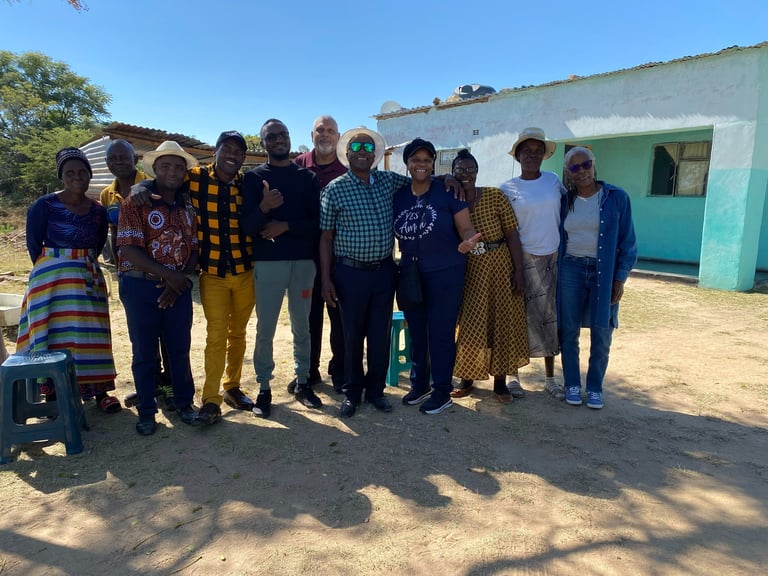
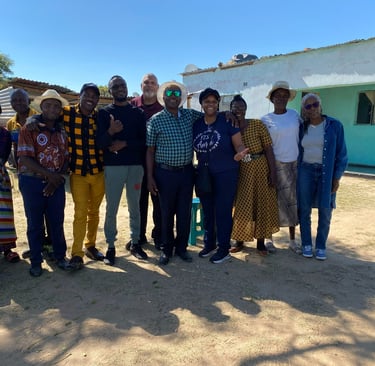
And then, there it was—the moment we had all been waiting for. A man with a huge smile, wearing a green plaid shirt and a white hat, stood at the end of the driveway. Other family members rose to greet us, hands pressed together in a prayer-like gesture. Even the animals seemed to sense the excitement, marching before our car while a friendly dog wagged his tail as if to say, “Welcome home.”
We couldn’t get out of the car fast enough! The smiles, the long embraces, the laughter—this was one of the most heartfelt welcomes of our lives. It felt as though long-lost children were finally coming home. The man who greeted us was our relative, Uncle Pius—affectionately known as “Unc.” The family around him was lovely. The women’s bright smiles, smooth skin, and colorful African attire glowed with joy. The men stood strong and proud. We all shared familiar traits—cheekbones, noses, smiles—that made us feel instantly connected. But what stood out most about Unc was his eyes. Anyone who knows the Jacksons, including me and Denise’s grandfather, Ezell Jackson, would instantly recognize that signature trait: eyes that shimmer in hues of hazy light, hazel, gray, or soft blue. Seeing those eyes in Unc felt like looking into a reflection of our own family line. When I mentioned documenting this unforgettable experience, the Village Head graciously gave his blessing to use real-life photos—a gesture that made the moment even more meaningful.
The village itself was larger than we imagined—families living close together, caring for one another, just as the saying goes: “It takes a village to raise a child.” It reminded me of visiting my grandparents in Spartanburg, South Carolina, where generations of family lived nearby—grandparents, cousins, aunts, and uncles—all intertwined by love and shared history.
Unc then led us to a traditional Zimbabwean kitchen, a place that immediately wrapped us in warmth and belonging. We sat on a circular stone bench around a pot and an open flame at the center of the floor. Unc expressed his joy and gratitude for our visit, but honestly, the honor was ours. We had dreamed of this moment for years, and now here we were—living it.
Inside that humble kitchen, a delicious meal awaited: chicken, rice, and potatoes with rich gravy—one of the most organic and flavorful meals we’d ever tasted. Of course, we all went back for seconds, washing it down with an orange drink that looked like Tang but tasted even better.
A traditional Zimbabwean kitchen holds deep meaning. Usually round, with smooth clay-plastered walls and a thatched roof, it’s the beating heart of rural life. At its center sits the choto, a three-stone hearth where clay pots (hari) bubble with sadza, vegetables, or stew. Low stools surround the fire, while shelves display pots, cups, and gourds used for water or traditional beer. The polished earth floor—made of clay and cow dung—keeps the room cool by day and cozy by night. But beyond its beauty, this kitchen is a gathering place for stories, laughter, and love. We couldn’t have been more honored to experience this tradition—and the hands that prepared it.
✨ Have you ever visited a traditional village kitchen? What was cooked, and what memories did it leave behind? Share your thoughts below!
Looking ahead, we’ll delve deeper into our family’s history, including sensitive questions about the African slave trade, and learn who the Village Head is and what his role means within the community. This journey has only just begun.
👉 Subscribe and come along with us as we continue uncovering our roots and reconnecting with the family who never stopped waiting for us.